
In movies and television, real estate developers are almost exclusively portrayed as villains whose plans to build something new must be prevented at all costs by the story’s hero. It’s a storytelling trope that’s been around for at least 75 years.
However, the prevailing notion that most, if not all, real estate developers are corrupt and greedy is false. Like all stereotypes, that of the “greedy developer” may be based in some truth. But, the supposed greed and corruption of developers has been exaggerated far beyond reality while the many positive effects of new development often go unmentioned in popular culture.
This situation stems, in part, from the complex nature of real estate development itself. It is a difficult undertaking that requires expert knowledge and grit to get good results. This makes it difficult for those outside our industry to understand. But because your development will impact the community in which you are building, along with residents’ daily lives, many people feel like an authority on the subject. Criticisms abound from the these “armchair quarterbacks,” who, having never participated in the development process believe they could do a much better job.
Extensive regulations and drawn-out permit processes combine to make real estate development difficult by nature. Community opposition and NIMBY attitudes make it that much harder. It’s challenging to create meaningful projects, but not impossible. Given the constraints, real estate developers who accomplish projects that generate value for the community should be highly regarded, not hated.
The Future of Real Estate Development
In a country where there is a shortage of housing and millions of acres worth of placelessness, the demand for new development is extremely high. To solve the cultural and economic issues facing our society, we need a wider range of housing options along with more walkable, community-centered commercial and retail areas. This has, in fact, been the focus of many real estate development firms for decades.
Whatever role real estate developers of the past played in the proliferation of the now-unpopular strip malls and chaotic suburban sprawl, the fact is that in order to create the types of developments currently in demand we still need real estate developers. Those who criticize all new development without consideration forget that the very buildings and streets they love were, at one time, developed. That new development needs to happen to fulfill current needs is not in question.
Instead, the question ought to be: How do we create developments of sufficient quality and value?
In the ongoing saga of real estate development, developers cannot serve as both hero and villain. It’s time to move beyond the narrow stereotypes of the past and recognize the essential position developers are in to improve the way we all live.
Breaking down the “greedy developer” stereotype begins with recognizing a community’s unfilled needs and providing a way to meet them. The key to a successful project, both culturally and economically, is creating the places people will want to experience.
3 Ways to Improve Your Community Reputation as a Real Estate Developer
Consider how the following tips can help you as a developer build a solid reputation for doing it right and leave the “greedy developer” stigma behind.
1) Follow the Market Trends
People across the country are struggling to find places to live that meet their needs and expectations. Many locations no longer work for the lifestyle that most people desire.
For example, there is a substantial gap between the demand for walkable neighborhoods and the current availability. Even before the pandemic, outdoor amenities were rapidly rising in popularity. Further, the convenience and community strength provided by mixed-use developments is also in short supply.
Real estate developers who ignore these and other key market trends in an attempt to save money not only run the risk of being characterized as careless and greedy, but ironically end up making far less profit. With so much demand for walkability, outdoor amenities, convenience, and community, providing these features is not just “right” thing to do. It’s the smart thing to do.
Follow the market trends and build communities that fulfill people’s wants and needs. By doing so, you’re reshaping a story where new real estate development enriches neighborhoods and builds a brighter future for the entire community.
2) Create Memorable Places
New development projects are rarely criticized for doing too much. In fact, it’s usually the opposite. Projects are usually pegged as lifeless, boring, and even ugly.
For example, the very common 5-over-2 apartment buildings that provide much-needed housing in rapidly growing urban areas can end up looking very similar to each other. Building codes and financial constraints make variations in form nearly impossible and variations in material difficult to pull off. As a result, the finished project is often indiscernible and forgettable.
Yet, there are many such buildings that are still able to stand out and draw excitement from the surrounding community. How? The developers and architects intentionally go above and beyond to make some part of the development memorable.
Real estate developers that continually try to play it safe by keeping unique and original design features out of their projects are actually taking on a big risk. They’re risking both the dreaded association with “cookie-cutter” developments and the inability to stand out in a competitive market.
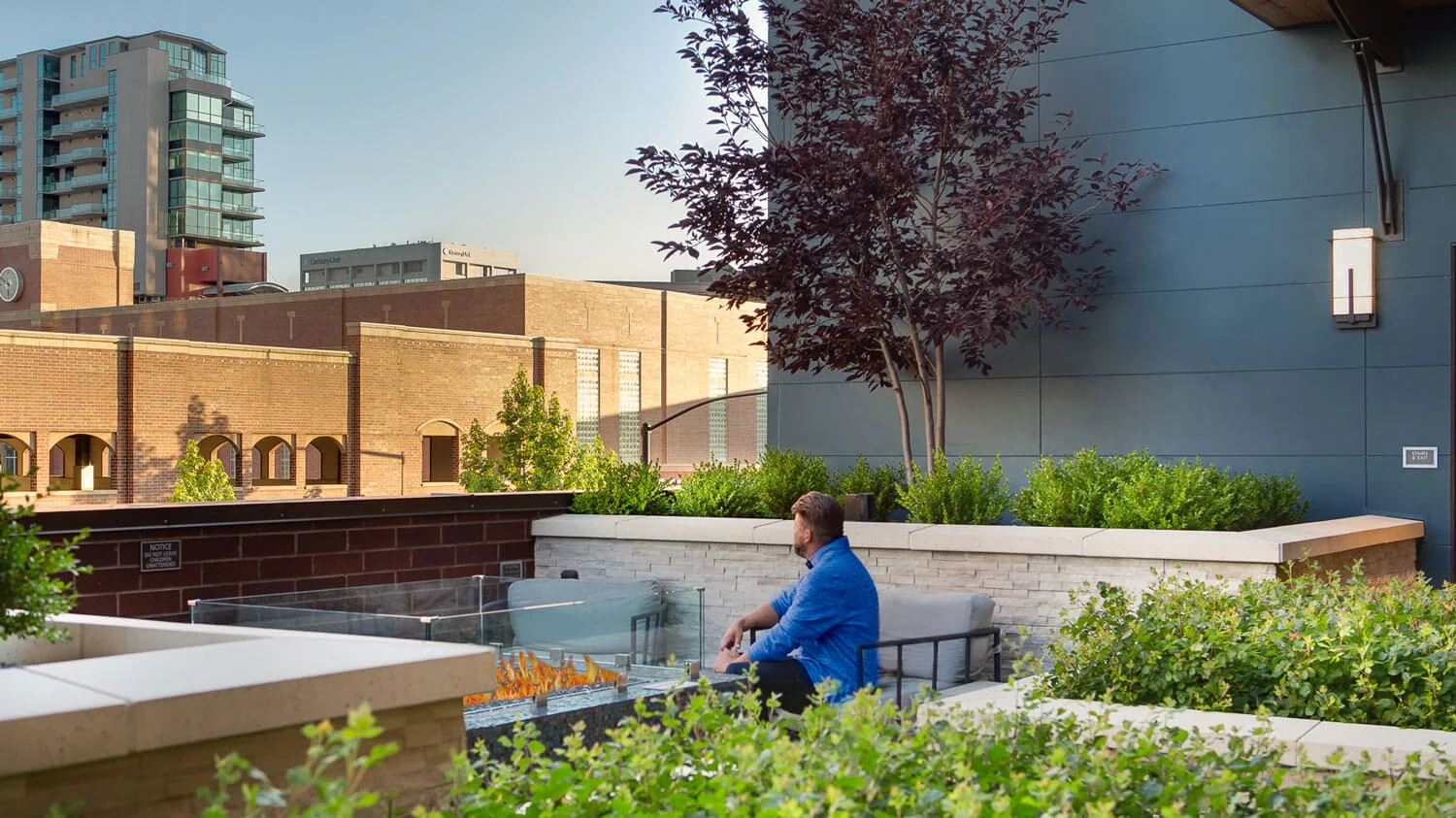
Create salient, iconic design features that stand out in people’s minds. For example, introduce bespoke site furnishings and custom fire or water features instead of the standard off-the-shelf alternatives. A unique environment must have a branded combination of experiences made specifically for your project.
Make Instagram-worthy spaces that draw people to your development. Go beyond standard checklist items such as a pool or gym and offer amenities that your tenants won’t be able to find somewhere else. When you provide one-of-a-kind experiences, tenants and neighbors alike will look beyond the building type and start to associate your development with bigger and better things. You’ll know you’ve been successful when people want to stop and take a photo in the space.
3) Invest in High Quality Properties
Real estate developers are often accused of “cutting corners” to save money. Any perceived deficiency experienced by the tenants is chalked up to greedy developers being cheap.
Overcoming this key component of the “greedy developer” stereotype is really just a change of mindset. When developments are correctly viewed as investment opportunities, it’s not so much about spending less money as it is about investing correctly to bring in the highest returns.
Consider this: Would you rather have an empty building or a building that you put some extra costs into but is completely leased? Would you rather hang on to your capital or invest it in a property that is generating massive returns?
The adage “you get what you pay for” has never been more true. Nowadays what separates the finest development properties from the rest is both the magnitude and the manner of the investment. Invest in higher quality by paying more for greater design solutions, better materials, and more amenities. Each of these, when properly considered, will amount to higher returns and more community buy-in.
The Bottom Line
Being the best developer you can be not only serves the community in which you’re building. It ultimately leads to more success and profitability. It will take time and effort to fully extinguish the greedy developer reputation, but someday it will be clear how much good real estate development can do for our communities. The progress that comes from positive change will be apparent as more real estate developers follow market trends, create memorable places, and invest in high quality.